
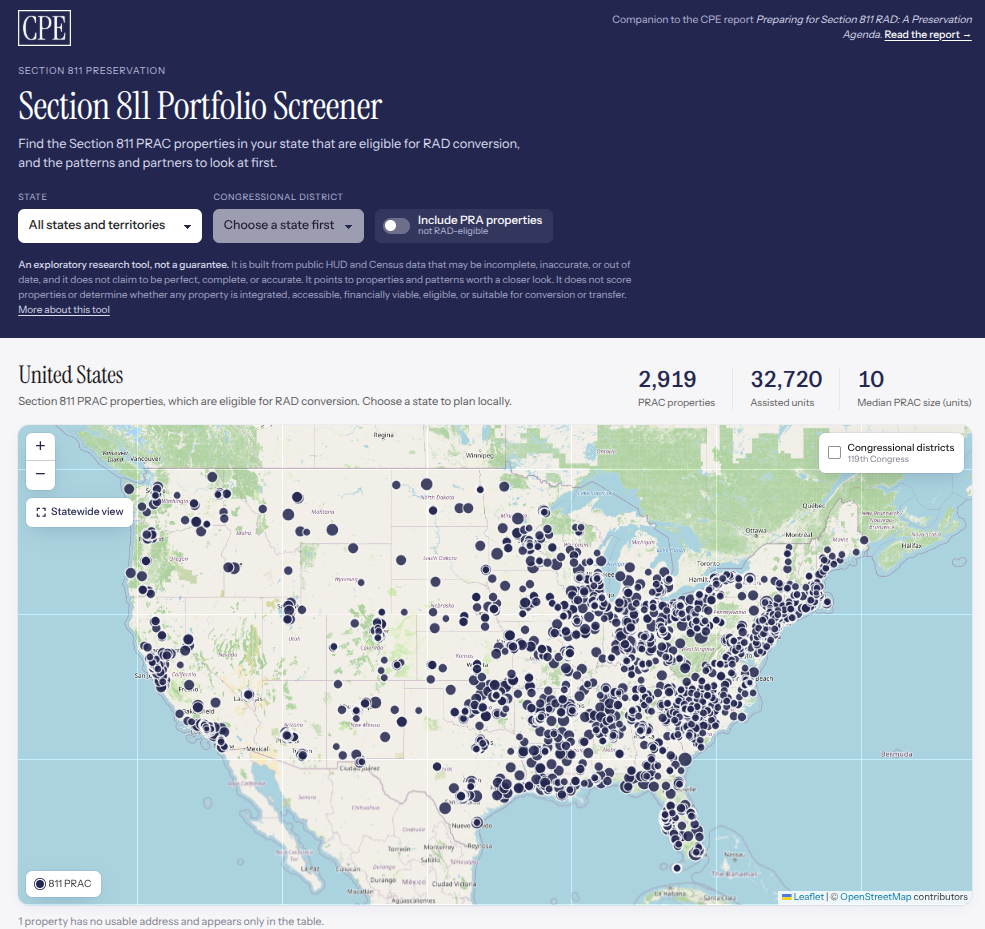
The recently enacted 21st Century ROAD to Housing Act raised the cap on public housing units eligible to convert under the Rental Assistance Demonstration (RAD) by 100,000 to 555,000. But there was arguably a more interesting change for RAD made back in 2022 that has received comparatively less attention. The Fiscal Year 2022 appropriations bill authorized HUD to incorporate a RAD option for the preservation of Section 811 properties with existing project rental assistance contracts (PRACs).
Compared to the millions of households served by the public housing and housing choice voucher programs, the Section 811 program is modest, serving a little over 38,000 very or extremely low-income individuals with long-term disabilities. The risks associated with the loss of this portfolio of housing, however, are significant. The average household income for a Section 811 PRAC resident is just $14,937, and the vast majority rely on non-wage income like Supplemental Security Income (SSI). According to the Technical Assistance Collaborative, there is no housing market in the United States where SSI alone would be enough to afford the rent for a typical one-bedroom apartment, let alone one that is accessible and located near services and supports. Losing these affordable homes, therefore, would put Section 811 households at risk of homelessness or institutionalization.
All of this makes managing the rollout and implementation of RAD to preserve the Section 811 portfolio critically important. HUD is still developing the framework for conversion of these properties, but the portfolio’s successful preservation will require coordinated action across HUD, Congress, state health and housing agencies, and owners.
Preservation will require more than just transferring existing rental assistance contracts to a more stable, long-term platform. Many Section 811 properties are small, aging, and may be difficult to finance through traditional programs like the Low-Income Housing Tax Credit (LIHTC).
Figure 2. 811 PRAC property distribution by assisted unit count
| Assisted units | Properties | Share |
|---|---|---|
| 1–4 | 348 | 12% |
| 5–6 | 567 | 19% |
| 7–8 | 354 | 12% |
| 9–10 | 319 | 11% |
| 11–14 | 601 | 21% |
| 15–24 | 685 | 23% |
| 25–49 | 45 | 2% |
Owners may need support to assess capital needs, scope and undertake accessibility improvements, and meaningfully engage residents. Access to voluntary services is a crucial component of Section 811 resident well-being and stability, but could be disrupted in the process of rehabilitation and conversion. Each actor in the system has an important role to play:
Congress should provide dedicated preservation funding: capital investment to support properties that may have insufficient cash flow to take on commercial debt or are too small to merit LIHTC; supplemental rental assistance to support operating costs and additional leverage where feasible; predevelopment and technical assistance for small nonprofit owners; and dependable resources for service coordination to help properties manage the transition conversion and rehabilitation will require.
HUD, through the RAD Notice and associated guidance, should establish workable conversion procedures and financing rules suited to small properties, allow portfolio conversions that enable consolidating or aggregating contracts, issue clear accessibility and integration guidance, and enforce resident protections with sufficient capacity to ensure adherence through implementation.
States, particularly Housing Finance Agencies (HFAs) and health and human services/Medicaid agencies, have an opportunity to proactively prepare. HFAs can assist with aggregating individual RAD conversions to access suitable financing and coordinate gap subsidies where available. Close coordination between state housing agencies and state health and Medicaid agencies, health systems, and service providers can help maintain continuity of services and promote resident stability.
State and local leadership is even more important in light of the current administration’s retreat from enforcement of the Americans with Disabilities Act, and in particular its position that the integration requirements for people with disabilities, upheld by the Supreme Court in Olmstead v. L.C. are not required by federal law. This does not absolve states or property owners from their underlying legal obligations; rather, in the absence of clear guidance from HUD or enforcement by the Department of Justice (DOJ), it will likely fall to states to determine what Olmstead compliance looks like in the context of an 811 RAD conversion and encourage conversions that promote integrated and supportive settings.
In this report, we provide an overview of the Section 811 program and portfolio, identify priorities for Congress and HUD, and outline actions state agencies can take now to prepare. Ultimately, federal investment and state coordination must advance together to preserve these properties and support the residents who call them home.