

Cyberattacks below the threshold of catastrophic risk are taking down basic public services.
On November 4, ransomware shut down digital services at one of the country’s largest library systems. The attack on Queens Public Library hit all 66 branches, taking its Wi-Fi, public computers, and self-checkout systems offline along with all of its web and app services. Another ransomware attack hit Columbia, South Carolina, two weeks earlier: the city’s IT department detected the attack on Oct. 20 and called in the State Law Enforcement Division. Residents were not able to use the city’s app to report common infrastructure problems (e.g., potholes and streetlight issues), reserve parks, access city maps, or reach animal services online, and the shelter even had to close temporarily. Columbia restored access to affected apps roughly a month later, but Queens has yet to announce a full restoration.
Over just a few months, incidents like these have become commonplace across everyday services used by millions. In early October, cities and counties in Nebraska, Missouri, New Mexico, Utah, and Texas faced additional public service disruptions. This summer water utilities in at least seven states reported incidents involving control devices that were exposed to the internet, some causing loss of pressure and flooding.
Pressure on these services is likely to grow as AI accelerates the discovery of flaws in widely used software. Monthly vulnerability disclosures more than doubled over this year alone, with Google clocking 5,045 in January 2026 and 10,740 by August. One recent suggestion aimed to direct that capacity toward civic infrastructure—compensating researchers who find vulnerabilities in public systems and shielding them from the liability this security testing currently invites. This idea addresses the ways vulnerabilities are found but leaves open important questions about their repair. Any proposed solution must be verified and installed, and responsibility for both steps must rest with someone the public system can trust.
States are well positioned to answer these questions, and have a variety of tools at their disposal to address them in novel ways. Many state offices already procure security services for their agencies and local governments. Federal grant funding could extend that arrangement to state programs that compensate members of the public with cybersecurity expertise to find and repair security vulnerabilities with codified protections for participants. Institutions that administer government services day to day stand to benefit the most.
Security teams stretched thin
The offices that manage these systems are often unable to assign more than a few staff to security, and those employees are typically responsible for other tasks. The Government Accountability Office found that small and medium water systems generally depend on plant operators for cybersecurity, many of whom have little-to-no training in the field, a pattern the Foundation for American Innovation has also highlighted.
Local governments are bound by similar constraints, with some dedicating just one team member to information technology and cybersecurity. As a result, securing infrastructure competes for staff time with routine operations—competition that hinders an institution’s ability to monitor disclosed vulnerabilities.
At the state level, technology agencies regularly manage systems for dozens of departments, which can lead to delayed critical security updates. The Virginia Information Technologies Agency (VITA), which serves about 65 executive branch agencies, set a 30 day standard for patching critical vulnerabilities. In 2024, the state’s legislative watchdog reported that, although VITA’s patch rate was improving, about half of its critical vulnerabilities were not resolved within that timeframe.
Large county governments with their own security teams are overextended as well. Even before large language models came into wide use, attackers breached Suffolk County, New York’s network in late December 2021 through Log4Shell, a Log4j software flaw that had become public about ten days earlier. The county wasn’t able to patch every system running the affected software, and its security team fielded hundreds of alerts a day while the attackers continued to access the network for the following nine months. By then, ransomware had forced local 911 dispatchers back to pen and paper. Response and recovery cost the county about $25 million, and a bipartisan legislative investigation recommended a “significantly” larger in-house security team.
Suffolk’s experience shows that a government’s size does not necessarily determine its level of investment in skilled cybersecurity labor, but expanding that workforce requires recurring funding that one-time federal grants do not provide.
Legal risks
Outside researchers could look for flaws that short-staffed institutions can’t find on their own. AI now allows them to review more software in less time.
In October, the Department of Homeland Security’s Cybersecurity and Infrastructure Security Agency (CISA) published six vulnerabilities in open source software that collects measurements from power substations, with two of them rated critical. Causal Security, the startup credited with the initial report in CISA’s advisory, attributes all six to its AI agent. Additionally, Anthropic gave 11 partners—from major technology companies to the Linux Foundation—early access to Claude Mythos Preview, an unreleased model, to find and patch flaws in critical software through its Project Glasswing. According to the company, the model found “thousands of zero-day vulnerabilities… in every major operating system and every major web browser.” These advancements open an opportunity for states to have more of their own software examined than in-house staff could cover alone.
That said, testing a government system without permission can be a crime or grounds for legal action. Only one state, Washington, safeguards good faith researchers against prosecution in its computer crime law. In practice, a researcher who finds and reports a vulnerability in a public system is protected at the discretion of the officials involved. The federal Computer Fraud and Abuse Act considers unauthorized access an offense and allows for civil suits over as little as $5,000 in alleged losses.
In Missouri, this discretion was all that stood between a reporter and the consequences of a criminal referral. After a St. Louis Post-Dispatch reporter found over 100,000 educators’ Social Security numbers in the page source of a state website and alerted the relevant state office, the governor referred that reporter to prosecutors. The county prosecutor declined to charge, describing Missouri’s own computer-tampering statute as “so vague that it basically describes someone using a computer to look up someone’s information,” but exceptions for good faith research have not been added. The Justice Department issued a policy against prosecuting good faith research several months later; this guidance has no force of law and leaves state charges and civil suits on the table.
Existing law broadly discourages unsolicited offers of the support state and local agencies require. A 2021 Supreme Court decision and a federal copyright exemption each offer independent researchers some protections, but neither extends to testing a system without its owner’s permission, and formal invitations to test public systems remain rare. Georgia’s General Assembly passed a bill in 2018 that would have made unauthorized computer access a crime even without intent to cause harm, but then-governor Nathan Deal vetoed it, citing concern that it could limit available pathways to protect against cybersecurity threats. Even Washington state’s exception for white hat security research applies exclusively to criminal charges and has yet to be tested in court. Federal efforts to write an exception have also stalled over concerns that it could shield extortion, and a bill announced this year by Senators Josh Hawley and Chris Murphy would add liability for AI agents without any announced research protections.
When governments fund them, programs that invite independent testing of public systems have strong track records. A decade ago, the Pentagon’s first bug bounty drew 138 eligible reports for about $150,000—the department estimated that an outside firm would have charged over $1 million. Moreover, federal civilian agencies have been legally obligated to authorize good faith research since 2020, and some states have followed.
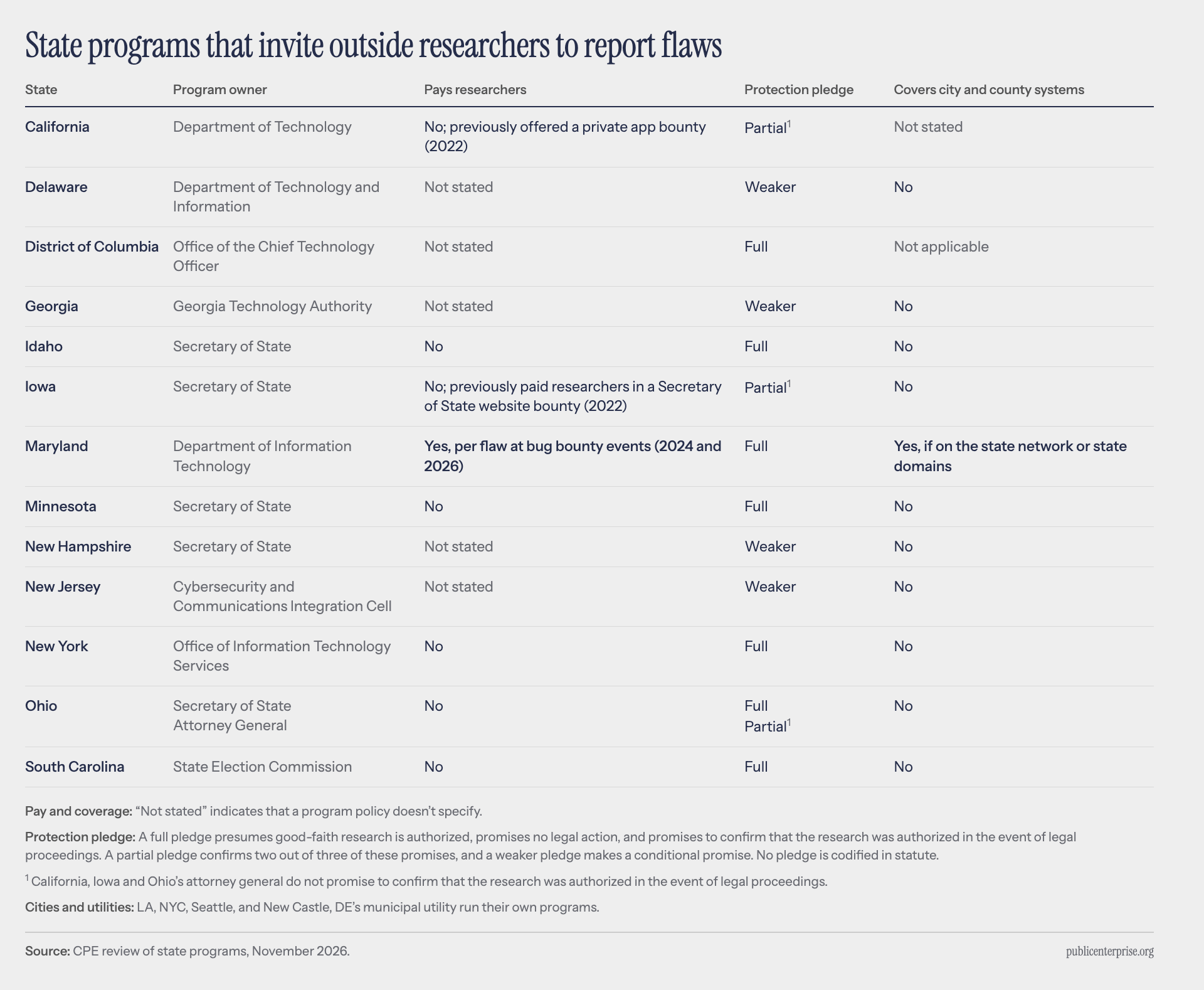
Maryland paired a commitment not to recommend legal action with a single statewide channel for reports, taking the federal model to its agencies beginning in October 2025. The state also extends compensation on a per-find basis at its periodic bug bounty events. Researchers’ findings have led to more than 200 fixes since the programs started. Maryland is an exception, however. As is, about a quarter of states run programs for white hats, but only Maryland and Iowa have paid researchers. Maryland also has the only program to accept external reports about local government systems.
The federal model behind Maryland’s approach is available to any state that authorizes independent researchers to access its systems. Most states have left that opportunity open.
Fast to discover, slow to repair
Compensation and legal protections for outside researchers would help governments find more vulnerabilities, but discovery is just the first step. Knowledge was not the gap that led to Suffolk County’s breach, and knowledge is not what prevented VITA from meeting its deadlines.
Attackers increasingly exploit vulnerabilities when they become public. Google counted 141 exploited vulnerabilities from January through August of this year—more than in all of 2025—and attributed the increase mainly to “the rapid weaponization of n-days,” vulnerabilities whose patches have been released but not yet widely installed.
Published patches also vary in what they cover. Out of CISA’s six published vulnerabilities in substation software, only one of the two rated critical received a patch update, and two others received safer default settings that apply only to new installations. DEF CON Franklin, a joint program between DEF CON, the National Rural Water Association (NRWA), and the University of Chicago Harris School of Public Policy’s Cyber Policy Initiative, placed 27 volunteers with 21 small water utilities in seven states, but did not include the funding or personnel necessary to act on their recommendations, and some utilities ultimately set them aside for other priorities. In each case, the burden of responsibility for repair remained with the system’s owner regardless of who identified the vulnerability.
This burden is measured in staff time and costs, and with public funding, AI could reduce it. Six weeks into Project Glasswing, Anthropic reported that 75 out of roughly 530 high- and critical-severity open source vulnerabilities disclosed through the program had been patched, and named “the human capacity to triage, report, and design and deploy patches” as a central bottleneck in the pace of repair. A RAND paper argues that organizations would be more “willing to incur the time and expense” of repair if AI could generate those patches for a substantially lower cost. Public procurement that sources repairs alongside discoveries can directly lower those costs.
Several programs already underwrite repairs to open source code, and at least one proposal would finance many more. OpenAI’s Patch the Planet initiative funds security researchers to support developers of open source software. As of November, OpenAI reports over 700 patches have been produced with 500 accepted through this program. Finalists in DARPA’s AI Cyber Challenge, which has awarded $8.5 million in prizes, patched 43 of 63 vulnerabilities planted in open source projects. DARPA and ARPA-H have also offered another $1.4 million, paid in $10,000 increments, each time a challenge finalist demonstrated its system was able to locate and patch new vulnerabilities in approved critical infrastructure software. The Institute for Progress’s Operation Patchlight outlines $2.4 billion in federal funds over three years directed to open source security nonprofits whose funding would cover patch generation and inspection, and to AI tools for infrastructure defenders.
Unfortunately, states have no equivalent programs.
State grants as repair infrastructure
But they don’t have to start from scratch. Congress created the State and Local Cybersecurity Grant Program (SLCGP) in 2021 after ransomware attacks disrupted city services in Atlanta and Baltimore. Where Patch the Planet and DARPA’s challenge were intended to repair specific code, the program aimed to support local government capacity to secure their systems. The SLCGP divided $1 billion among states and territories over four years, requiring at least 80 percent of each award to pass through to local governments. States can deliver this share to local governments as cash subawards or “items, services, capabilities, or activities” that the state provides them, subject to local agreement.
During the first three years of the program, 16 of 48 states classified for this analysis relied entirely on services, 11 combined services with subawards, and 21 disbursed funds as subawards to local governments. Illinois has 6,930 local governments—more than any other state—and delivered its entire local share as services. In fact, the 16 services-only states account for over a third of all local governments nationally. Those states that used some or all of their local share as services already executed the contracts and secured the written local agreements that a state repair program would require.
A state repair program would extend those contracts and local agreements to repairs.
External researchers could write patches for the vulnerabilities they identify or apply patches that vendors have released. The state could assign the program to an office able to review repairs as quickly as researchers submit them—before they’re integrated into live systems. DARPA’s top 2025 AI Cyber Challenge finalists still created patches that were incorrect in 16 to 21 percent of cases. Each state would set two features of the program:
- Compensation. A state could offer a standing prize for each accepted repair or run a contest-to-contract model.
- Liability. A program would support agencies vetting researchers and approving patches before updates go live. The program’s terms would both authorize researcher access to enrolled systems and assign responsibility in the event a repair that passes review later proves faulty.
Two types of legal protections are necessary to cover researchers, one for repairs and one for discovery and disclosure. Authorization through a program of this kind would cover repairs because federal liability hangs on whether permission was granted by the system’s owner, which a formalized state program can guarantee. States that wish to support independent submissions should look to Washington’s computer crime law (RCW 9A.90) for model definitions of terms such as without authorization and white hat security research that protect independent researchers from criminal prosecution. Other legislatures could go further, expanding protections to include civil suits in addition to criminal charges.
Program authorization for the SLCGP expired on September 30, but bipartisan support for renewal continues despite stalls. In November 2025, the House passed a seven-year renewal by voice vote and a bipartisan Senate bill proposed a one-year extension, but neither has become law. FY2023 and 2024 awards remain open until late 2027 and early 2029 respectively. States can redirect a portion of their available federal funds to new projects with local consent and federal approval. That investment could support repair programs of this kind. States need not wait for Congress to act while threats to public services grow.
Cover photo: Seattle City Light’s Gorge Dam, which appears in Alan J. Pakula’s The Parallax View (1974).