
‹ People

Advait Arun
Reports
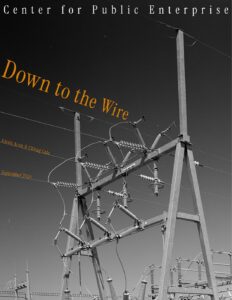
Down to the wire
There is no mechanism that translates federal and regional identification of critical interregional transmission links into concrete projects that secure financing or access to a cost recovery framework. This report embraces the urgency and necessity of a federally coordinated macrogrid and enumerates the reasons why existing grid planning, financing, and cost recovery structures cannot bring it about. A federal macrogrid coordination process should procure new transmission lines on the basis of a sufficiently anticipatory planning process, provide financing for those lines to be built in advance of demand signals, and eliminate uncertainty over how those new lines will recover their costs when they begin operating.
Research note: Using RFIs to build project pipelines for clean energy
Read the full research note here. This research note by the Center for Public Enterprise and the State Support Center focuses on how RFIs can serve as a procurement strategy for public agencies with project finance, development, and/or ownership authorities. RFIs can be a valuable tool for state and municipal instrumentalities to (1) gather information […]

Research note: Energy finance in 2026
Every January, the project finance law team at Norton Rose Fulbright (NRF) brings together bankers and infrastructure investment experts to discuss trends across the American energy and infrastructure finance landscape. Their annual Cost of Capital outlook is a deep well of information that allows our team to support our state and local government clients. Last year, we summarized the takeaways we believed were worth policymakers’ attention. This year, we’ll do the same—but we’ll be drawing from more sources.

Bubble or Nothing
Policymakers concerned about the deployment of clean energy and compute-focused infrastructure over the long term need a framework for managing the uncertainty in the AI sector's investment landscape—and for understanding the local and regional impacts of a market correction that strands data centers and their energy projects.

What’s next for the LPO?
Read the full report here. Read our abridged list of recommendations here. Executive Summary The One Big Beautiful Bill Act, now made law, looks better for the Loan Programs Office than what the Senate Energy and Natural Resource Committee had initially proposed. That first draft both rescinded funding for and repealed the authorities of all […]

Committing to the Drill Bit
Read the full report here. Executive summary Proponents of enhanced geothermal energy are correct that this nascent technology has incredible potential to decarbonize the U.S. energy system. Enhanced geothermal systems (EGS) share drilling technologies with the shale fracking industry, making them a compelling option for policymakers looking to leverage existing American supply chains to drive […]
Posts
Long-term liquidity for long-term public capital planning
The federal government has several options beyond what it authorized in BIL and IRA to empower state and local government investment in critical infrastructure that both lowers costs and helps drive decarbonization and resilience.

National transmission needs study 2026
Our submission contributes to our team's work identifying barriers to bankability for large-scale energy infrastructure and describing how public financing and planning tools can break coordination bottlenecks for transmission in particular, with benefits for the interconnection of large loads and clean energy generation resources.

Next-generation geothermal project finance
Despite the technical similarities between next-generation geothermal and shale fracking, next-generation geothermal technologies are an altogether different asset class—and, as such, their deployment at scale requires a different approach to the problem: project finance.

The path forward for nuclear tax credit monetization
Nuclear developers have practical reasons to be concerned that the investment tax credit, large as it is, cannot easily provide them with upfront construction-period support.

Public enterprise for a thriving economy
In late 2025, the Sustainable Energy and Environment Coalition (SEEC) Institute released a Request for Information (RFI) seeking ambitious economic policymaking strategies that advance affordable and abundant decarbonization and infrastructure resilience. CPE submitted its response in December 2025. We believe this submission adequately summarizes much of the public-facing work the CPE Energy Team has done over the past three years.

Holding Down the Fort: What States Can Do To Advance Decarbonization
CPE’s Director of Energy Yakov Feygin and Senior Associate for Capital Markets Advait Arun prepared a research memo for the SEEC Institute outlining how states can advance decarbonization and green industrial policy amid federal uncertainty. This memo draws on CPE’s work with state agencies and municipalities nationwide, and demonstrates how tools like green banks, revolving […]

One big beautiful blackout
It’s not just about cost—the bill text imposes new and perhaps insurmountable uncertainties on project developers and investors.